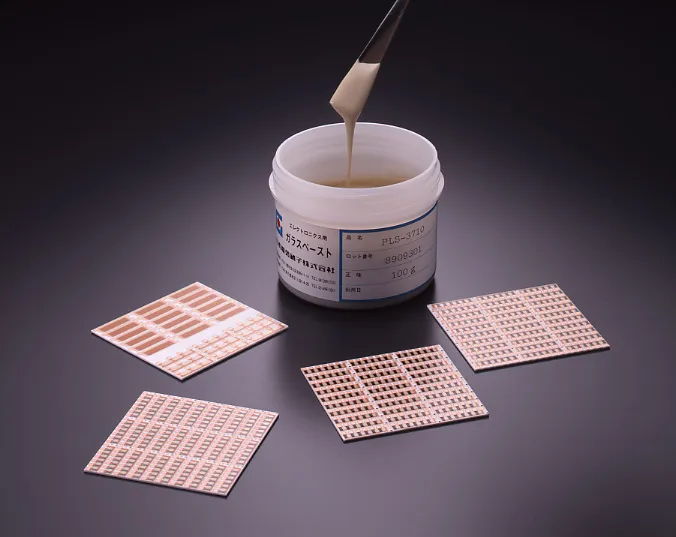
Low Temperature Sealing Glass
Sealing glass is made by blending low-softening point glass powder with special ceramic powder. By adjusting the combination and blend ratio of these powders, we can achieve a variety of sealing temperatures and coefficients of thermal expansion to meet specific requirements.
Properties 1
LS-2010 is widely used for DIPs and QFPs made from alumina, which has a coefficient of thermal expansion of approximately 70×10⁻⁷/K.
LS-1401S, with a sealing temperature of 380°C, is ideal for SMD packages used in quartz crystal oscillators, where low-temperature sealing is particularly beneficial.
LS-3051S is suitable for low expansion ceramics like aluminum nitride, which has a coefficient of thermal expansion of about 45×10⁻⁷/K.
LS-1301 and BF-0901 are used for applications involving silicon.
| Application | Alumina | Aluminum nitride, mullite, silicon | |||||
|---|---|---|---|---|---|---|---|
| Properties/Glass Code | LS-1401S | LS-2010 | LS-3051S | LS-1301 | BF-0901 | ||
| Sealing temperature | ℃ | 380 | 435 | 430 | 450 | 560 | |
| Dielectric constant | 1MHz, 25℃ | 45.0 | 12.5 | 16 | 45.5 | 11.1 | |
| tanδ | 1MHz, 25℃ | ×10-4 | 38 | 34 | 41 | 60 | 19 |
| Coefficient of thermal expansion | 30~250℃ | ×10-7/K | 71*1 | 65 | 51 | 41 | 49*2 |
| Transition point | ℃ | 258 | 313 | 303 | 315 | 430 | |
| Softening point | ℃ | 355 | 400 | 390 | 390 | 528 | |
| Density | ×103kg/m3 | 7.02 | 5.67 | 5.95 | 6.77 | 4.69 | |
| Volume resistivity Log | 150℃ | Ω・cm | 6.2 | 12.4 | 12.7 | 12.0 | 13.3 |
| Thermal conductivity | W/m・K | 0.98 | 1.45 | 1.24 | 0.84 | 1.47 | |
| Specific heat | ×103J/kg・K | 0.34 | 0.41 | 0.38 | 0.35 | 0.46 | |
| Acid resistance | 20%H2SO4, 70℃, 1min | mg/cm2 | ー | 0.8 | 1.1 | 0.1 | ー |
| 10%H2SO4, 20℃, 10min | mg/cm2 | ー | 0.5 | 0.9 | 0.1 | ー | |
| 10%HCl, 20℃, 10min | mg/cm2 | ー | 1.9 | 2.7 | 0.5 | ー | |
| 10%HNO3, 20℃, 12min | mg/cm2 | ー | 120 | 120 | 123 | ー | |
| Color tone | Black | Brown tint | Black | Black | Green | ||
| Composition system | PbO and B2O3 (composite) | Bi2O3 and B2O3 (composite) | |||||
-
Coefficient of thermal expansion is measured in the range of 30 to 200°C
-
Coefficient of thermal expansion is measured in the range of 30 to 300°C
For lead-free options or additional properties not listed above, please contact us.
-
Printing and Drying (Except LS-1401S)
Add a vehicle to the powder glass and mix thoroughly to form a paste. A suitable vehicle is a low-molecular-weight acrylic resin dissolved in 5% terpineol. Use a stainless steel screen with an 80–100 mesh size for printing. Dry the printed material at 120°C for 10–20 minutes. Repeat the printing and drying process until the desired coating thickness is achieved. -
Temporary Baking
Carry out temporary baking in air or oxygen to remove the resin from the coating film. Since the decomposition and firing of acrylic resin are most active between 320°C and 380°C, increase the temperature gradually within this range. Maintain the peak temperature for about 10 minutes to ensure complete resin removal. -
Lead Sticking
Perform lead sticking in air, holding the material at the solidification temperature for 5–7 minutes. If using a heater block, set the block surface temperature 30–50°C higher than the sticking temperature and hold for 1–2 minutes. -
Sealing
Conduct sealing in air or nitrogen and maintain the material at the sealing temperature for approximately 10 minutes.
For additional details, please refer to the downloadable document.
Property 2
-
Composite System
-
-
Our sealing glass can bond various glass substrates and metals efficiently in a short time.
-
-
Crystallinity
-
-
Crystalline glass is produced by growing crystals within softened, flowing glass. It’s possible for the glass to maintain its shape during reheat processing.
-
| Properties/Glass cord | LS-3075 | LS-3081 | LS-0118 | LS-0206 | LS-7105 | BF-0606 | ||
|---|---|---|---|---|---|---|---|---|
| Sealing temperature | ℃ | 450 | 410 | 430 | 450 | 450 | 485 | |
| Coefficient of thermal expansion |
30~250℃ | ×10-7/K | 36.5 | 74 | 72.5 | 72 | 85* | 73* |
| Density | ×103kg/m3 | 6.91 | 6.89 | 7.05 | 6.82 | 6.37 | 6.05 | |
| Transition point | ℃ | 300 | 300 | 317 | 325 | ー | 365 | |
| Flexion point | ℃ | 330 | 320 | 337 | 353 | ー | 393 | |
| Softening point | ℃ | ー | 365 | 390 | 410 | 400 | 450 | |
| Volume resistivity Log | 150℃ | Ω・cm | 10.8 | 12.2 | 11.2 | 13.2 | 10.4 | 12.0 |
| Color tone | Black | Green | ||||||
| Composition system | PbO and B2O3 (composite) |
PbO, ZnO, and B2O3 (crystalline) |
Bi2O3 and B2O3 (composite) |
|||||
| Application | Alkali-free glass | Soda flat glass, 50 Alloy, and 426 Alloy |
||||||
-
Coefficient of thermal expansion is measured in the range of 30 to 300°C
For lead-free options or additional properties not listed above, please contact us.
-
Printing and Drying
Combine powder glass with a vehicle and mix thoroughly to form a paste. A suitable vehicle is a low-molecular-weight acrylic resin dissolved in 5% terpineol. For printing, use a stainless steel screen (80–100 mesh). Dry the printed paste at 120°C for 10–20 minutes. -
Temporary Baking
Conduct temporary baking in air or oxygen to eliminate the resin from the coating film. Since the binder decomposes and fires most actively between 320°C and 380°C, increase the temperature gradually within this range. Maintain the peak temperature for about 10 minutes. -
Sealing
Carry out sealing in air or nitrogen.
For further details, please refer to the downloadable document.